The Countries That Want Nothing to do With the European Union and Why?

Being in the European Union is supposed to be a desirable thing for European countries and the idea is that the many are greater than the few – that by ‘teaming up’ the EU can take on the other global super powers and look after its own. Being in the EU affords a country trade benefits, increases tourism and ensures that member countries have the support of their neighbours should they ever need a bail out or other financial aid – so what’s not to like?

Norway

Well actually a fair bit if many countries are to be believe. There are more than a couple of countries you see that don’t want to be in the EU, despite being in Europe and having that option should they want it. So what’s going on? Here we will look at which countries are shunning the EU and just what it is that they don’t like…

Norway isn’t in the EU though it works very closely with the union and is a member of the ‘European Economic Area’ and ‘European Free Trade Association’. So why isn’t Norway more interested in membership? Well certain political parties in Norway seem to think that the EU is undemocratic – such as the Socialist Left Party which describes there as being a ‘lack of democracy’ and ‘too much focus on Liberal trade’ and the Christian Democratic Party which believes Norway could lose some of its independence were it to join.

A more cynical view though may be simply that the EU is less beneficial to Norway because Norway is in a relatively strong financial position. As the wealthier member states of the EU are often tasked with bailing out the poorer ones, it may be that Norway has more to lose and less to gain than some other countries.

The UK

While the UK does belong to the EU, there is widespread controversy surrounding this issue. The problem here is that the EU involves itself in so much of the UK’s law-making. High profile cases in the news have drawn attention to this fact with Aston Martin being ‘forced’ to release a Mini (in order to keep down their ‘average’ engine size), motorcyclists forced to pay more for modifications and the government being forced to keep known terrorists in the country because the EU deems deportation to be a breach of their human rights.
This kind of decision making from ‘on high’ has led many Brits to resent the EU and thus David Cameron (the current Prime Minister) has promised to hold a referendum on the matter should Conservatives win the next election.

Turkey

Turkey has been an ‘associate member’ of the EU for a long time and has a history of attempting to join the Union. In 2007 President Nicolas Sarkozy of France blocked the Chapter on Statistics and Financial Control and in 2009 a further 6 chapters were blocked by the Republic of Cyprus arguing that Turkey needed to formalise relations with them.
While the Turkish prime minister R.T. Erdogan has made it clear that he intends to continue pursuing membership, enthusiasm for the idea has since cooled within Turkey. This may be in part a reaction to the blocks (a ‘you don’t want us so we don’t need you’ mentality) but there are also real complaints that membership could hurt tourism which generates a lot of income for Turkey.
Many tourists from Europe visit Turkey every year and one of the big draws are the many ‘all inclusive hotels’ that offer cheap meals and entertainment for a single, low price. If Turkey were to join the EU however, the all-but inevitable switch to the Euro might mean this was no longer feasible and in general prices could go up. Of course Turkey has also been made to jump through all kinds of hoops to be considered for membership which has also upset a lot of residents.

Greenland

Greenland hasn’t just rejected EU membership, but actually chosen to leave – making it the first country to do so. After a disagreement regarding fishing rights, the territory left the EEC but remained subject to EU treaties via the Association of Overseas Countries and Territories.

Since then, the reduction of EU red tape and the destructive Common Fisheries Policy (that allowed other countries to fish in Greenland’s waters) has allowed the country to go from strength to strength. Greenland is actually now better off than before and in fact the islanders enjoy a higher standard of living than those in Britain, France or Germany.

Take from that what you will but this is something that could also benefit the UK which is also reliant on fishing exports. Today more British workers lose their jobs thanks to the Common Fisheries Policy than from mine closures. Something to think about…

Posted under Europe

This post was written by admin on August 23, 2015
The Best Technology to Take With You to Europe

The Best Technology to Take With You to Europe

If you’re going to Europe for an adventure, and if you’re someone who likes to travel more than you like to holiday, then you need to ensure that you pack the right gadgets and the right supplies with you to make the most of the trip and to make sure that you don’t find yourself in trouble. Travelling without creature comforts, staying in hostels and making it all up as you go along is a lot of fun – and particularly in Europe – but it’s also inherently risky and there’s a lot that can potentially go wrong.

By keeping us connected, and by giving us more resources, our technology can enhance our capabilities and help us to stay safer. Here we will look at some of the ways that your technology can be useful when you travel to Europe, and at some of the very best gadgets to take with you.

Kindle

When visiting Europe, a Kindle is an absolutely fantastic device that can make life easier in a whole range of ways. First of all, Kindles are great devices if you do just want a beach holiday. This is because they are so light, yet still manage to give you access to a library of thousands of books. At the same time, they also have a great ‘e-ink screen’ that means you won’t struggle with glare even when you look at your device in direct sunlight.

Most impressive of all though, is the fact that Kindles provide you with 100% free 3G anywhere in the world. If you’re struggling to find a WiFi hotspot then, you can use your Kindle in order to get very basic internet access (it’s slow and black and white – but it’s better than nothing), and you can then use this to check e-mails, to look up directions or to perform other basic tasks that might just get you out of a pickle.

Tip: If you can’t find the browser right away, look under ‘experimental’. On some versions the concept is still in Beta.

Smartphone

Of course taking a smartphone is useful pretty much wherever you go, and Europe is no different. While you won’t be able to access 3G without getting a serious charge (it’s crucial you remember to turn off your ‘data roaming’ unless you want to rack up a massive bill), you should find that most hotels offer Wifi, as do most cafes that you’ll be able to find walking around town. This then means that you can access a wealth of functions on your device that are very helpful for travellers.

For instance you can use Google translate in order to look up what things mean (though take the answers with a pinch of salt – they aren’t always 100% accurate). Likewise, you can use currency conversion apps (or again the Google one) in order to check prices and get more of a ‘feel’ for the value of money in the country you’re visiting. Better yet is using Google maps to find your way around – if you get lost you can just stop off at a café to quickly see which way you’re meant to be heading (try taking a screenshot so you can work from the map offline too).

Of course it’s also very important to have a phone on you in general, so that you can make emergency calls if you get into trouble, and so that your friends and family back home are still able to reach you as well.

Laptop

If you have a smartphone then you won’t necessarily need a laptop – particularly if you’re travelling and trying to keep your bag light. However, if you’re on a business trip, or if you just want to be able to watch films in your hotel room/check the web properly, then you may want to consider taking one.

The best laptops for this sort of travelling used to be netbooks which are light, cheap and have a good battery life. Now though another new class of device has emerged to offer an even better alternative: the tablet computer.

The best example of this is the Acer Iconia W3. This is an 8’’ tablet that runs full Windows 8 and offers around 10 hours of battery life. It barely weighs anything, but comes with a full-sized keyboard accessory for anyone who wants to work on the go.

Alternatively you could just take an Android tablet. With a Nexus 7, you’ll have a device that’s light enough to easily slip into a bag, and the Android operating system should be versatile enough to meet most requirements. If you need to input more text more quickly, then you could always consider investing in a small kickstand and Bluetooth keyboard to turn it into almost a full PC.

And the best thing about either of these devices is that they’re perfect for reading the news or a copied of Wired while sitting in your hotel room with a mug of coffee.

GPS

Finally, if you’re driving, then a GPS Sat Nav is an absolute must. This can help you to avoid getting lost on unfamiliar roads and could even be a lifesaver in an emergency. While many car rental companies will offer a sat nav thrown in when renting in Europe, you shouldn’t take this for granted and it’s worth checking that before opting to leave your Sat Nav out of your luggage.

Special Mention Goes To…

Of course it’s not technology in the way that most of us think of it, but if you want to take a tool that will be incredibly useful with you to Europe you really can’t beat the notepad and pen. In many ways it can do everything a smartphone or tablet can do – you can draw pictures to pass the time/capture the experience or play hangman with friends, you can jot down notes and reminders, you can draw out routes and maps and you can even use it as a handy communication tool. If you’re struggling to order a beer in the pub, then a quick sketch can help you to get by and amuse the locals. And it doesn’t even matter if it gets lost…

Sometimes the old ones are the best!

Posted under Europe

This post was written by admin on February 9, 2014

Should You Rent a Car or Go By Train When Traveling Through Europe?

Should You Rent a Car or Go By Train When Traveling Through Europe?

One of the big benefits of Europe if you’re a traveler is the simple fact that there are so many different countries, cultures and sceneries all situated so close to one another (and that the EU makes it so easy to travel between them). This then means it’s possible to visit multiple countries in the continent in a single go rather than having to confine yourself to just one. Book a train or rent a car, plot your course through the countries you’re most interested in and set off on your way for an amazing adventure.

  Therein though lies the question – do you go by train or do you rent a car? Each option has a lot of advantages and disadvantages and will appeal to different kinds of traveller. Here we will look at both to help you make up your mind.

Why You Should Go By Car

  Road trip!! Going on any travelling holiday in a car has an instant appeal because it gives you privacy and freedom meaning that you can do whatever you like without being restricted or having to consider the feelings of others. On the train you’ll have to sit quietly looking forward, but when you’re in the car you can put on music and have a sing-along and the passengers can enjoy drinking beers.

  Another benefit of going by car is that it allows you to be impulsive and to really see whichever parts of Europe take your fancy. You’ll be able to see everything as you travel and this will enable you to just pull over at any point to explore. If you should happen to pass a nice spot in a field for instance, then you can get out and have a completely impromptu picnic.

  Also great is just how convenient having a car is in terms of eating and transporting luggage. If you travel by car for instance then you’ll be able to bring as much luggage as you want with you because you won’t have to carry it any point. You can stop off at a super market to stock up on food and eat while you’re moving and if you can’t find a place to stay you can even go to sleep in the car (not a first choice, but certainly a good backup).

  Finally, driving a car is fun and this in itself will give you a more authentic experience of the countries you’re visiting and make you more a part of the scenery.

Why You Should Go By Train

  While there are many benefits to going by car, it’s not for everyone and the train has a lot of perks too. The first perk of the train is of course that no one has to drive and this is particularly useful if no one in your party can drive. Even if you do have the ability to drive though, going by train means that no one has to miss out on drinking because they’re driving the next day and it means you won’t have any fallings out because one person is being a back-seat driver.

  A car can also be a burden in other ways – it means that you have to find somewhere to park whenever you stop and it means you can risk being broken into. This can cost money and waste time and in some ways it leaves you more restricted than you were before. Driving of course is also somewhat more dangerous itself – particularly as you might well be on the ‘wrong’ side of the road much of the time.

  When you travel by train this is also much quicker, which is a big factor you mustn’t forget. This in short means that you will get to see more places more quickly than you would in a car which might make your journey more rewarding as a result (particularly true as well if you are prone to getting lost occasionally – a train will drop you right off in the city centre). If you want to see more of Europe, perhaps consider going by train.

Rent a car in Europe

Conclusion

  There are many benefits to both train and car travel through Europe then, meaning that it will ultimately come down to your individual preference as well as the kind of trip you have planned. If you want to travel through lots of Europe quickly then going by train might be a better idea, while if you value a party atmosphere and bonding between friends more and are only visiting a smaller area then a road trip might be better.

  Another thing to consider though of course is the price. If you find the right deal you can actually travel through most of Europe relatively cheaply and there are few other costs to consider. At the same time though a car can be split between multiple people as can petrol – though note that fuel will be more expensive than in the US. If you can’t make up your mind, hunt for deals, check out Google maps and decide which is the most cost effective.

Posted under Europe

This post was written by admin on February 4, 2014

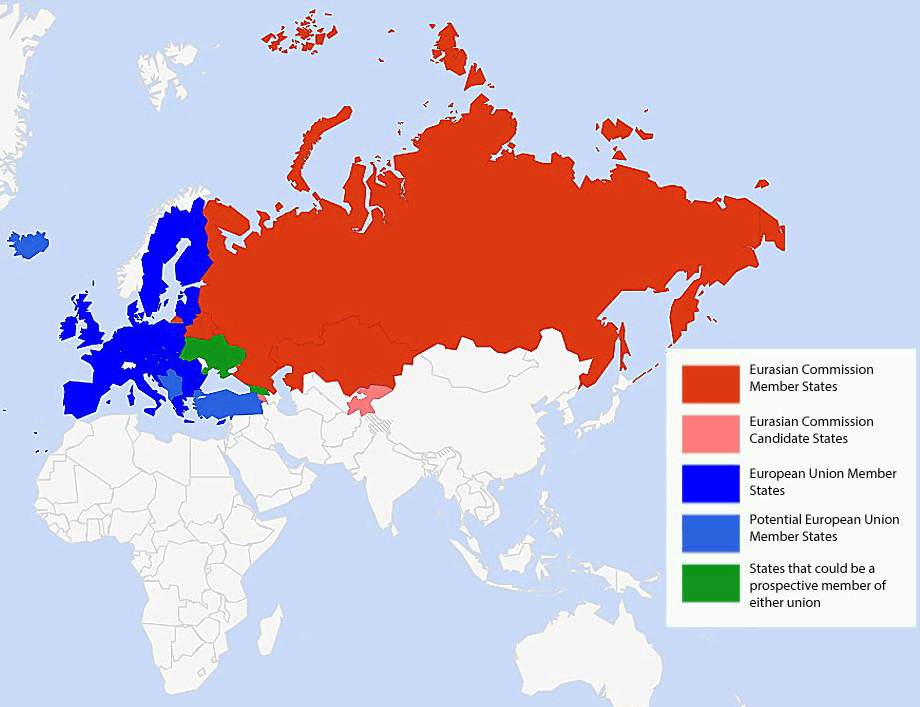
Russia and the European Union

Russia and the European Union

Russia and the European Union

Russia has a long history of strained relations with the West. Of course we all know about the cold war which nearly brought the planet to the brink of nuclear war, and both before and since they have made many other controversial moves which haven’t always won them friends in the rest of the world.

The relationship between Russia and the EU however is one that has always been complicated and which involves a number of complicated factors. For one, Russia is partly in Europe meaning that in theory it could probably join the EU if it wanted to (and if the EU let it). This leads us to question why it hasn’t, and whether it will do any time soon. How might the EU change if Russia were a part of the huge supranational organization?

And furthermore, it’s also interesting to consider Russia’s status as a neighbour of the EU. With Russia and the EU sharing a boarder, it’s no great stretch of the imagination to think that they may sometimes have disagreements.

Here then we will explore the complex relationship between Russia and the EU, both historically and as it stands. We’ll also look at what the future has in store for this complicated relationship and at how things might change.

Why Isn’t Russia in the EU?

EU membership is an issue in Russia, and several members of the EU have suggested that Russia should join. In one article that was published by the Italian media, the previous Italian prime minister Silvio Berlusconi described EU membership as the next step in Russia’s ‘growing integration’ with the West. Russia is also currently at odds with much of Europe after promising to deliver S-300 missiles to Iran.

Despite this however, critics have argued that Russia is ‘decades’ away from being fit for EU membership, citing civil rights cases (such as the Pussy Riot controversy), election issues, inflation requirements and more as reasons.

And Russia itself doesn’t seem to have much of an interest in joining the EU as it is anyway. After Berlusconi’s article was published for instance, the only response given by Russia was that it had no current plans to apply for membership. The sheer size of Russia means that it already has huge resources of its own to draw on, while the restrictions that the EU would impose would most likely be difficult for Putin and Russia to follow. He is after all a leader with a rather large ego, and not one who is likely to want to bend to the will of the EU.

If Russia were to join the EU, it would not necessarily be likely to benefit either party. There would no doubt be disagreements which would make it more difficult for new laws to be passed, while the huge size of Russia would potentially place quite a lot of strain on the rest of Europe. In short, the Euro could become devalued, though trade of course would be further improved.

Current Relations

So no EU membership then, but how is Russia’s relationship with the EU otherwise? Well… it’s not an unqualified success…

In 2009 for instance, Russia’s reputation as a gas supplier was hurt. This was due to a deal made between the EU and Ukraine to improve Ukraine’s pipelines. At this point, Vladimir Putin (prime minister of Russia) stepped in and threatened to review Russia’s relationship with the EU if their interests were ‘ignored’. Putin was worried that the EU getting closer to Ukraine could damage Moscow and called the move an ‘unfriendly act’.

Russia also has gripes with particular members of the EU over various matters. For instance, Russia banned Polish meat exports at one point due to allegations of low quality, which lead to Russia vetoing EU-Russia pacts regarding energy and migration as well as an oil blockade on Lithuania. The ban has since been reversed, but historically Russia and Poland have never gotten along well and it’s issues like this that might make Russia and the EU awkward bedfellows if ever they were to merge.

With the Winter Olympics set to take place in Russia, Europe and the rest of the world will have their eyes on the huge country soon. There have already been major problems however with misspending and poor budgeting, so this might do nothing to improve Russia’s standing.

That said, it isn’t all bad news. For one, the EU is still Russia’s largest trading partner by a large partner and accounts for roughly 52% of their foreign trade and 75% of their foreign investment. Likewise, the EU exports hundreds of billions of Euros’ worth of goods to Russia every year. This is still a mutually beneficial relationship then, and one that is worth maintaining – particularly with it being as delicate as it is.

Posted under Europe

This post was written by admin on January 26, 2014

The Countries That Want Nothing to do With the European Union and Why

The Countries That Want Nothing to do With the European Union and Why

Being in the European Union is supposed to be a desirable thing for European countries and the idea is that the many are greater than the few – that by ‘teaming up’ the EU can take on the other global super powers and look after its own. Being in the EU affords a country trade benefits, increases tourism and ensures that member countries have the support of their neighbours should they ever need a bail out or other financial aid – so what’s not to like?

  Well actually a fair bit if many countries are to be believe. There are more than a couple of countries you see that don’t want to be in the EU, despite being in Europe and having that option should they want it. So what’s going on? Here we will look at which countries are shunning the EU and just what it is that they don’t like…

Norway

  Norway isn’t in the EU though it works very closely with the union and is a member of the ‘European Economic Area’ and ‘European Free Trade Association’. So why isn’t Norway more interested in membership? Well certain political parties in Norway seem to think that the EU is undemocratic – such as the Socialist Left Party which describes there as being a ‘lack of democracy’ and ‘too much focus on Liberal trade’ and the Christian Democratic Party which believes Norway could lose some of its independence were it to join.

  A more cynical view though may be simply that the EU is less beneficial to Norway because Norway is in a relatively strong financial position. As the wealthier member states of the EU are often tasked with bailing out the poorer ones, it may be that Norway has more to lose and less to gain than some other countries.

The UK

  While the UK does belong to the EU, there is widespread controversy surrounding this issue. The problem here is that the EU involves itself in so much of the UK’s law-making. High profile cases in the news have drawn attention to this fact with Aston Martin being ‘forced’ to release a Mini (in order to keep down their ‘average’ engine size), motorcyclists forced to pay more for modifications and the government being forced to keep known terrorists in the country because the EU deems deportation to be a breach of their human rights.

  This kind of decision making from ‘on high’ has led many Brits to resent the EU and thus David Cameron (the current Prime Minister) has promised to hold a referendum on the matter should Conservatives win the next election.

Turkey

  Turkey has been an ‘associate member’ of the EU for a long time and has a history of attempting to join the Union. In 2007 President Nicolas Sarkozy of France blocked the Chapter on Statistics and Financial Control and in 2009 a further 6 chapters were blocked by the Republic of Cyprus arguing that Turkey needed to formalise relations with them.

  While the Turkish prime minister R.T. Erdogan has made it clear that he intends to continue pursuing membership, enthusiasm for the idea has since cooled within Turkey. This may be in part a reaction to the blocks (a ‘you don’t want us so we don’t need you’ mentality) but there are also real complaints that membership could hurt tourism which generates a lot of income for Turkey.

  Many tourists from Europe visit Turkey every year and one of the big draws are the many ‘all inclusive hotels’ that offer cheap meals and entertainment for a single, low price. If Turkey were to join the EU however, the all-but inevitable switch to the Euro might mean this was no longer feasible and in general prices could go up. Of course Turkey has also been made to jump through all kinds of hoops to be considered for membership which has also upset a lot of residents.

Greenland

  Greenland hasn’t just rejected EU membership, but actually chosen to leave – making it the first country to do so. After a disagreement regarding fishing rights, the territory left the EEC but remained subject to EU treaties via the Association of Overseas Countries and Territories.

  Since then, the reduction of EU red tape and the destructive Common Fisheries Policy (that allowed other countries to fish in Greenland’s waters) has allowed the country to go from strength to strength. Greenland is actually now better off than before and in fact the islanders enjoy a higher standard of living than those in Britain, France or Germany.

  Take from that what you will but this is something that could also benefit the UK which is also reliant on fishing exports. Today more British workers lose their jobs thanks to the Common Fisheries Policy than from mine closures. Something to think about…

Posted under Europe

This post was written by admin on January 22, 2014