Being the second smallest continent doesn’t imply that Europe is any less in power when it comes to making decisive impacts on the political history, geography and economy of the world. Infact, Europe is one of the most powerful continents in the worlds today, boasting of 11% of the world’s population. It is a center of economy, research, scientific progress and has always remained at the helm of political affairs of the world for years to come.
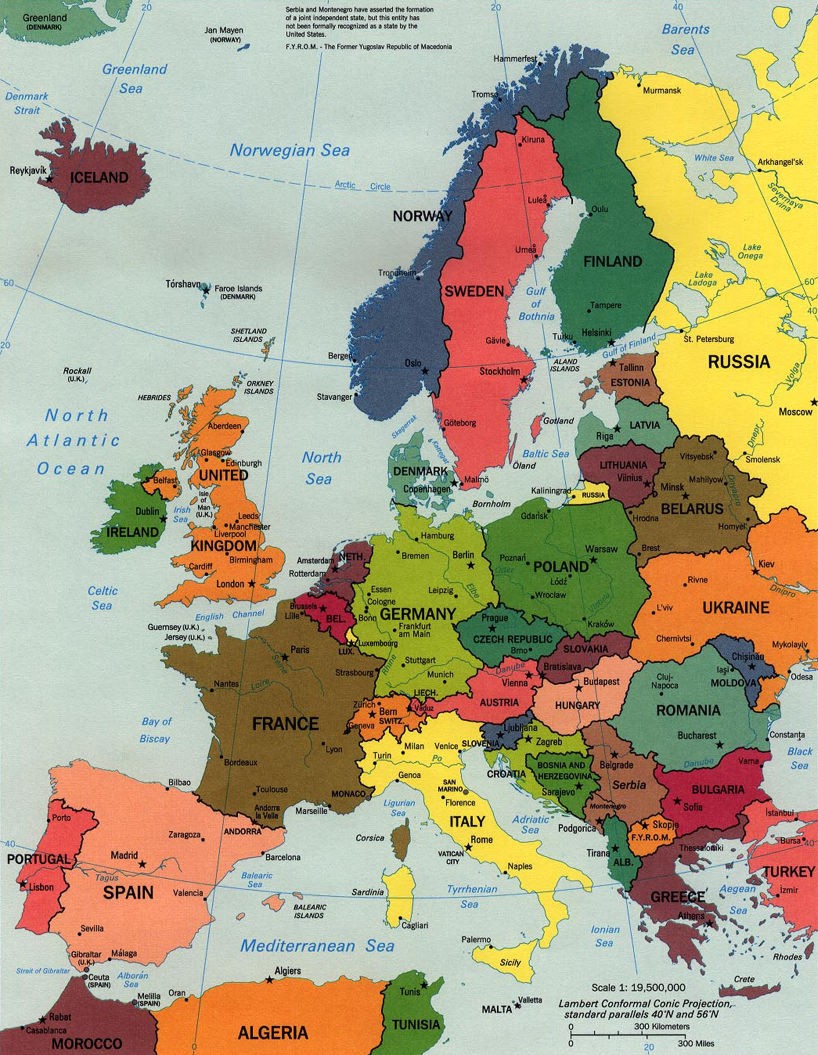
We all know how the countries of Europe shaped the world’s future during both the world wars and what impact those countries have had on everyone’s lives. Let us take a deeper look into what the Europe Political Map represents and what it stands for. Divided into two larger groups, Modern Europe is a conglomeration of Eastern Europe and Western Europe- the division being made on the basis of political and economic alliances between the countries. This is one of the foremost things we need to understand while analyzing Europe political map.
Countries like Belgium, France, Luxemburg, Monaco, Switzerland and Germany have been identified by the UN as ‘western Europe’. All of these countries lie on the western side of the continent, and share common economic, political and social goals. Similarly, countries towards the eastern part of the continent are referred to as ‘eastern Europe’. Countries like Belarus, Romania, Bulgaria, Germany, Russia, Czech republic, Ukraine and Slovakia fall under the formal UN definition of the term ‘eastern Europe’. These countries share common cultural and political goals. Trade among these countries is slightly restricted as compared to trade among the countries falling under the cadre of ‘western Europe’, but countries falling in the Eastern Europe cadre have a more prominent cultural, social and political bond. Prior to the break up of the Soviet Union, only states of Lithuania, Latvia and Estonia, coupled with a few Balkan states (such as those of Bulgaria and Greece) fell into the group of Eastern European nations.
This bi-polar nature of the Europe political map has led to a distinct culture at these two poles. While Western Europe has a capitalist outlook towards their political decisions, eastern European nations have a more socialist approach towards their political decisions. It is only a matter of time that we would be more clear as to how things shape up on the Europe political map and how would these situations impact the global thought process.
Posted under Europe
This post was written by admin on December 24, 2008